There are a lot of people building apps right now.
Open Claude Code. Describe an idea to Lovable. Spend a weekend working through the bugs, connecting a database, and getting the dashboard to look just right.
Suddenly, the idea you’ve been talking about for three years is an actual product.
I love this. More people should be able to build things.
But there’s a part of this conversation that gets a lot less attention.
What happens after you hit publish?
Because you can spend a month building something you’re proud of, launch it, and discover that almost nobody knows it exists.
Then you’re back in the editor, adding another feature.
At least that feels productive.
The app boom has a customer problem
The scale of this shift is hard to ignore. In November 2026, Lovable reported that its users had created more than 70 million projects.
Those projects aren’t all businesses. They aren’t all finished apps, either. But they show how many people are getting the chance to turn an idea into software.
My take: as more people gain access to the tools to build, finding customers becomes an even bigger part of the challenge.
Your potential users don’t know how many prompts it took to build your app. They care whether it solves a problem they actually have.
First, though, they have to hear about it.
And that’s where a lot of builders get stuck.
Marketing feels embarrassing because you have something to lose
Building gives you a relatively private place to figure things out.
You can break something, fix it, change your mind, and try again. Most people never see the messy part.
Marketing puts your judgment in front of other people.
You have to say, “I made this, and I think it’s worth your time.”
Someone might ignore you. Someone might say they don’t need it. Someone might try it and point out a problem you missed.
That feels personal when you’ve spent your nights and weekends building the thing.
So you tweak the homepage again. Add a settings page. Decide you need one more integration before you’re ready.
Sometimes you do need those improvements. Sometimes you’re giving yourself another week before you have to ask someone to use it.
Getting a product to market requires vulnerability. AI has made building more accessible, but it hasn’t removed that part.
For a founder starting without an audience, two options tend to dominate the conversation: run ads or start creating content.
Both can work. Both ask a lot of someone trying to get their first users.
Option one: run Meta or Google ads
Paid advertising has an obvious appeal.
You can put your product in front of people without first building a following. Google Search ads can reach people looking for a solution. Meta ads can introduce your app to people who weren’t actively searching.
But you need money to learn what works.
You’re testing the audience, the message, the creative, the landing page, and the offer. Then you need the people who sign up to actually use the product.
There are a lot of places for that process to break.
With Google’s cost-per-click bidding, for example, a click is what triggers the charge. A paying customer is still several steps away.
Here’s a hypothetical example.
Spend $500 and get 250 visitors. If 2% start a trial, that’s five trials at $100 each. If one eventually becomes a paying customer, your acquisition cost is $500 before you count your time or other expenses.
Those aren’t industry benchmarks. They’re simple numbers that show why affordable traffic doesn’t necessarily mean affordable customers.
Ads can become a great growth channel once you understand your buyer, your conversion rates, and what a customer is worth.
Early on, you may be paying to discover that you’re talking to the wrong audience or explaining the product badly.
That can be an expensive way to learn.
Option two: start making content
I’m a big believer in content. I make it myself.
A helpful video, article, or product walkthrough can build trust before you ever speak to a buyer. Over time, a library of useful content can keep bringing people to your business.
But “just build an audience” is a big assignment.
You’re learning how to write, record, edit, package ideas, and publish consistently while also building the product.
Creating a dependable audience can take months or years. Results can come sooner, but they’re difficult to schedule around the week you need your first ten users.
Search takes patience, too. Google’s SEO Starter Guide says some changes may take several months to show an effect, and some won’t produce a noticeable improvement.
Then there’s the emotional cost.
Recording yourself can feel awkward. Publishing something and watching it get almost no response can feel worse. If you’re camera shy, being told to post videos every day may sound exhausting.
You can absolutely create content without showing your face. Written posts, screen recordings, tutorials, and newsletters all count.
They still take time and effort. A founder who loves building software may have very little interest in becoming a publisher.
Content is powerful. It’s also a business function you have to learn and sustain.
The third option: go directly to the people who could use your app
There’s another route worth considering, especially if you’ve built a B2B app.
Find the people who have the problem. Reach out with a relevant message. Invite them to try your solution.
You don’t need thousands of followers to do that.
If you built an app for bookkeeping firms, start with bookkeeping firm owners. If you built a tool for recruiters, start with recruiters who handle the workflow it improves.
A specific person with a specific problem is a much better starting point than “anyone who might like my app.”
This is where an AI SDR can help.
SDR stands for sales development representative. An AI SDR automates parts of the work involved in finding prospects, starting conversations, and following up.
You still choose the market and explain why your product matters. The software helps carry out the outreach.
How Victoria AI helps you get those conversations started
We built Victoria AI to make that process easier.
Victoria helps you find prospects in its lead database or work from your own list. You can build sequences across LinkedIn and email, personalize messages using prospect information, and automate follow-ups.
Its AI reply capabilities help keep conversations moving, with a shared inbox and campaign analytics so you can see what’s happening.
For an app founder, that gives you a practical way to run a focused trial campaign: choose a buyer, explain the problem your app solves, and invite interested people to try it.
The message doesn’t need to be complicated.
For example, if you built software that helps agencies manage client approvals:
Hey Sarah, I built a tool for agencies that are tired of chasing client approvals across email threads. It puts feedback and sign-off in one place. Would you be open to trying it?
That’s an illustrative message, not a result from our campaign. But it shows the idea: give someone a clear reason to care and an easy next step.
The relevance matters more than the automation.
If you can’t explain why this particular person might need your app, sending more messages won’t fix the problem.
We’re using Victoria to market Victoria
Here’s a real example.
We’re running a LinkedIn campaign that introduces Victoria to potential users and offers a 14-day free trial.
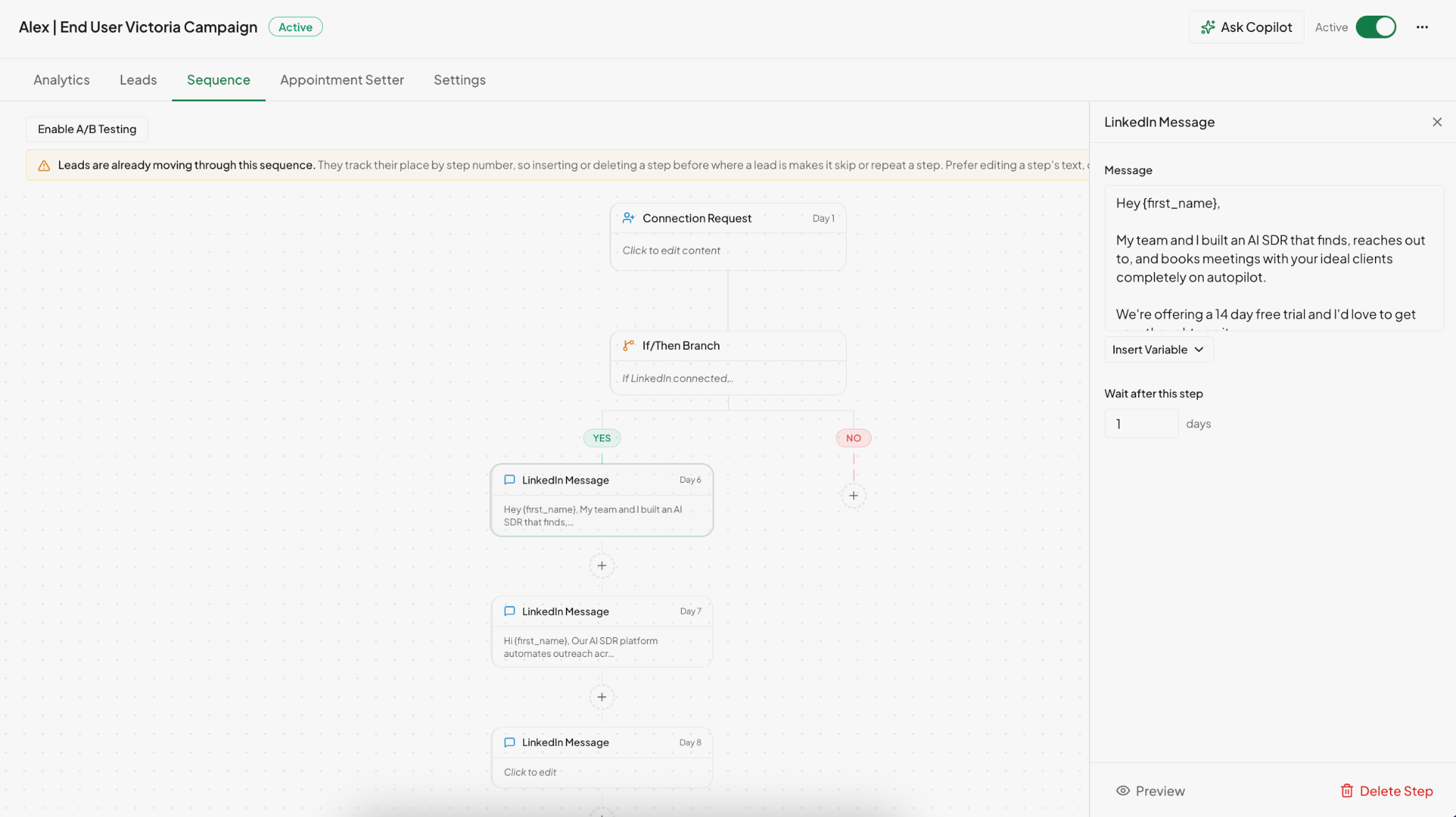
The sequence starts with a connection request, checks whether the person connects, and then moves into messages and follow-ups.
The opening message explains what we built: an AI SDR that helps find prospects, reach out, and book meetings. Then it introduces the trial.
According to our tracking, this campaign has generated 12 app signups over the last few weeks while the outreach runs on autopilot.
The campaign dashboard also gives us a view of the activity behind those conversations:
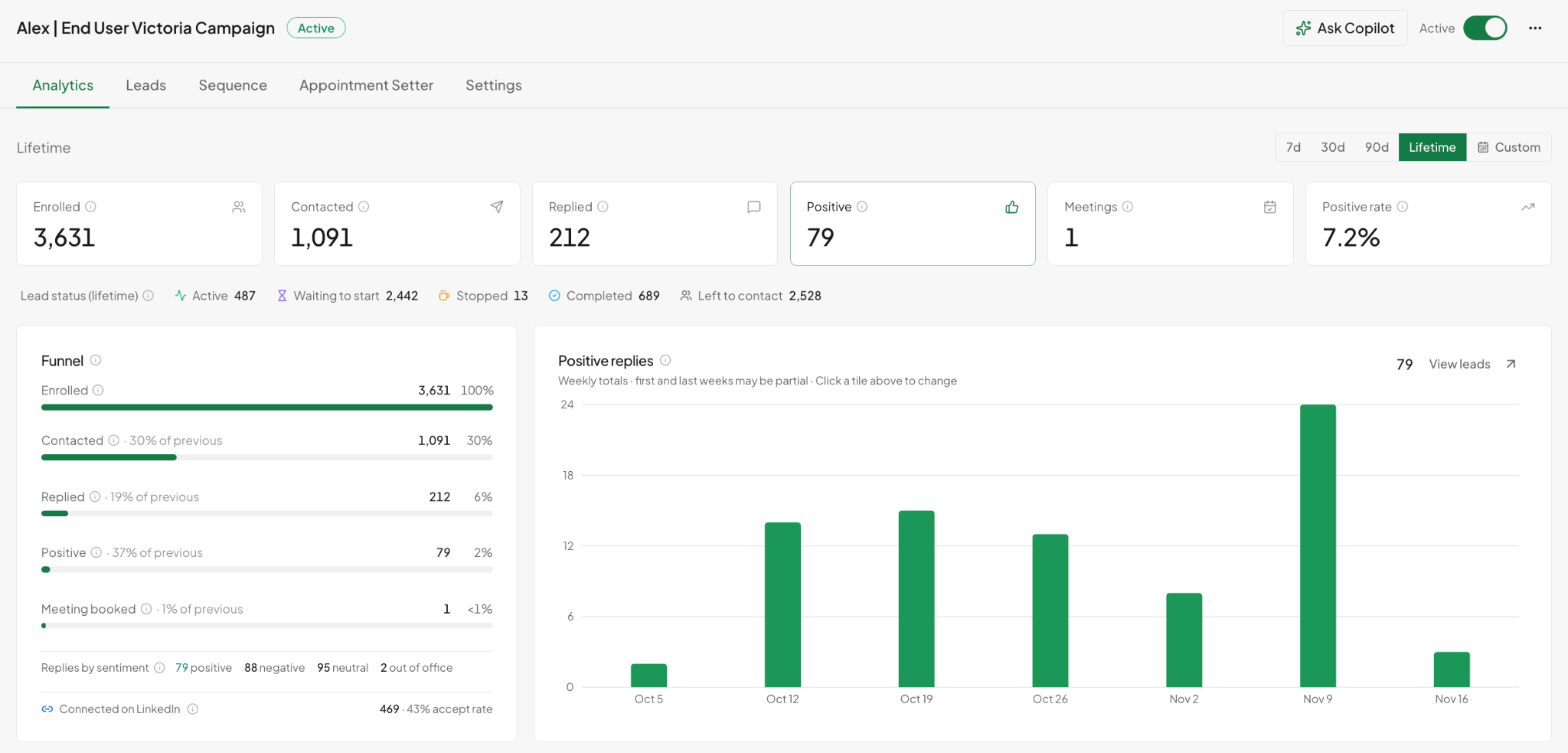
| Campaign metric | Lifetime dashboard total |
|---|---|
| People contacted | 1,091 |
| People who replied | 212 |
| Positive responses | 79 |
| Positive response rate | 7.2% |
That’s approximately a 19.4% reply rate among the people contacted.
The dashboard is set to its lifetime view. The 12 recent signups are tracked separately, so these figures shouldn’t be read as a single, matched reporting period.
And signups are the beginning. We still need to learn who activates, who keeps using the app, and who becomes a paying customer.
But this campaign is getting people into the product through direct outreach.
For a founder trying to move beyond “I built something,” that’s meaningful progress.
Your first users can help you decide what to build next
The value of outreach goes beyond the signup.
A reply can reveal that someone doesn’t understand your positioning. A question can expose a missing explanation on your website. A trial user can show you where onboarding becomes confusing.
Even “we already use something for that” can tell you which alternatives you’re competing against.
Those conversations give you something concrete to work with the next time you open your coding tool.
You might discover that the integration you were about to spend a week building matters less than making the first five minutes easier.
That’s a useful thing to learn early.
Outbound is particularly worth testing when your buyers are identifiable through their job, company, or industry. A broad consumer app may need a different approach.
And automation still needs attention. You need to review replies, improve the targeting, and help people succeed once they sign up.
It gives you a repeatable way to start conversations. You still have to earn the customer.
Give your app a chance to be used
You can keep improving an app indefinitely.
There will always be another feature, a cleaner design, or a new model to try.
At some point, you have to put it in front of someone who might need it.
Ads are one way. Content is another. Direct outreach gives you a third option you can test while you’re still figuring out the rest.
If you’ve built a B2B app and you’re ready to find its first users, that’s what we built Victoria to help with.
Try Victoria AI free for 14 days and start getting your product in front of the people you built it for.